Why Does Crop Length Matter More Than Size on a Petite Frame?
Quick Answer: On a petite frame the torso is shorter, so a cropped hem occupies a larger share of the visible upper body and a small difference in length changes the proportion substantially. A crop drafted for a longer torso ends up higher relative to your ribs and waistband, which is why the same size can feel entirely different between two brands. Length, not size, is the variable that determines whether it works.
You bought your usual size. It fits across the bust and the shoulders.
It still ends in a place you did not choose.
This is general information, not medical advice.
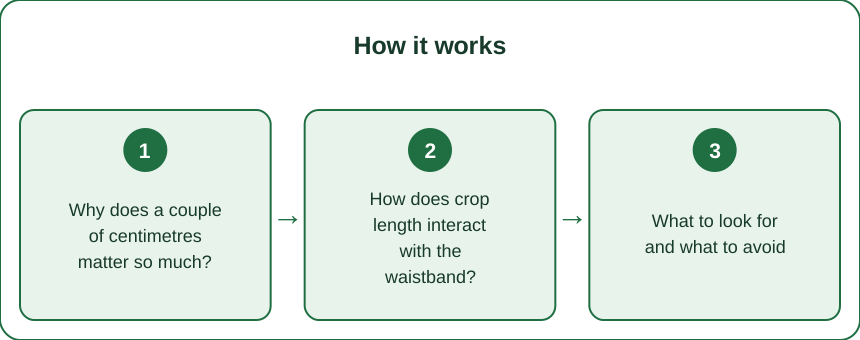
Why does a couple of centimetres matter so much?
Because proportion is a ratio, and the denominator is smaller.
On a torso measuring, say, thirty-eight centimetres from underbust to waistband, a hem that sits two centimetres higher than intended is a five percent change in the visible midsection. On a longer torso the same two centimetres is a smaller fraction and passes largely unnoticed.
Garment length is graded primarily by size rather than by height, which means a size small drafted for a 170 centimetre frame and worn by a 155 centimetre frame arrives with a hem that has effectively moved up several centimetres relative to the body.
The three landmarks it can land on are quite different:
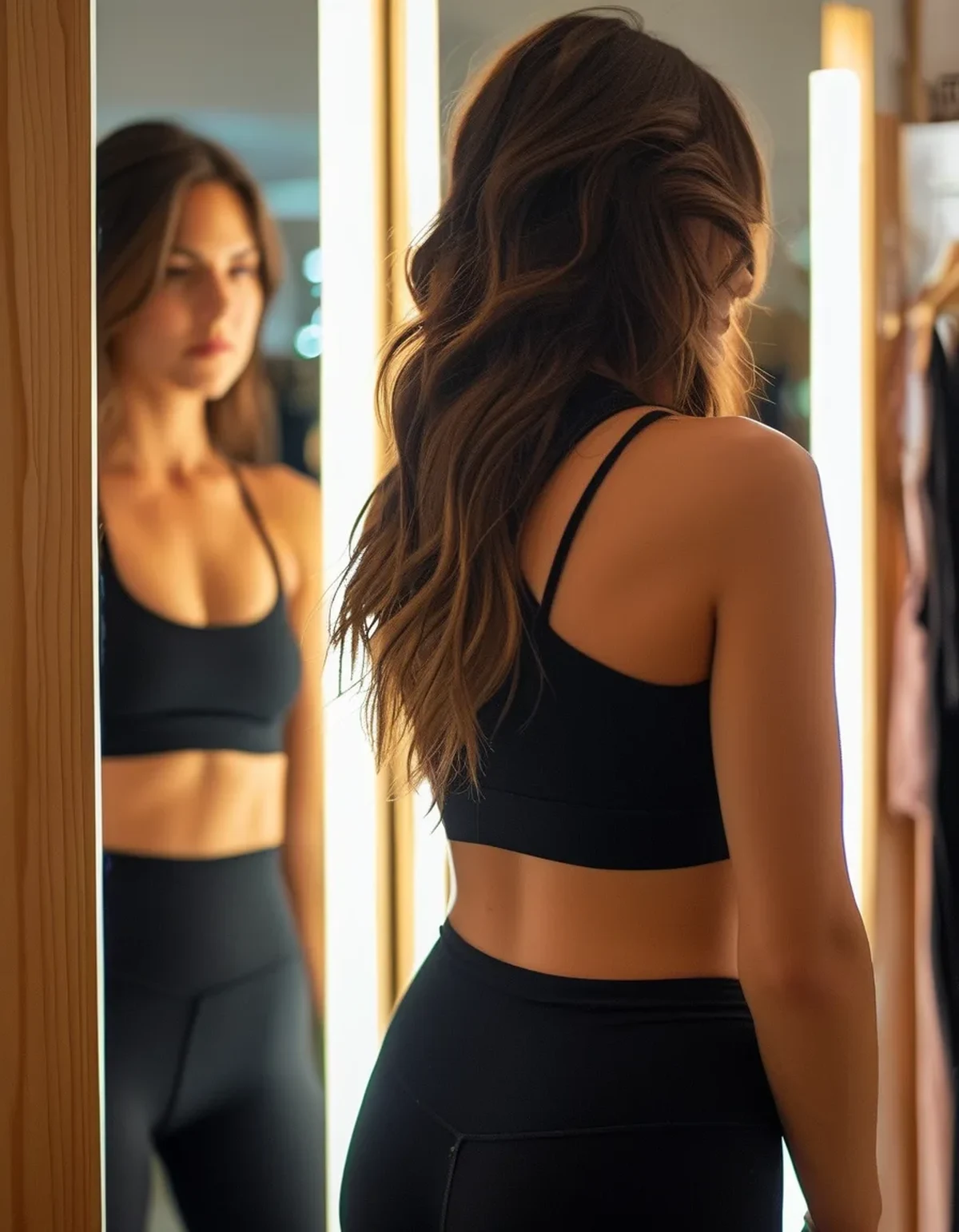
At or just below the underbust reads as a bralette or bra top. Legitimate as a deliberate choice, and rarely what someone intends when they order a cropped tee.
Mid-ribcage is the most versatile crop position for most petite frames. It shows the narrowest part of the torso and leaves enough length that the garment still reads as a top rather than as underwear.
Just above the waistband creates the smallest gap, works with high-rise bottoms, and is the most forgiving version for anyone who does not want a visible midsection at all.
The difference between those three positions can be as little as four or five centimetres, which is why length listed on a product page is more useful information than the size chart.
Is there a length that works universally?
No, and the useful move is to know your own preferred measurement. Measure a garment you like from shoulder to hem, and use that number when shopping rather than the size.
How does crop length interact with the waistband?
They have to be considered together, because what matters visually is the gap between them, not either one alone.
This is the piece most sizing advice misses. A crop and a high-rise legging can produce three completely different silhouettes depending on how much skin sits between them:
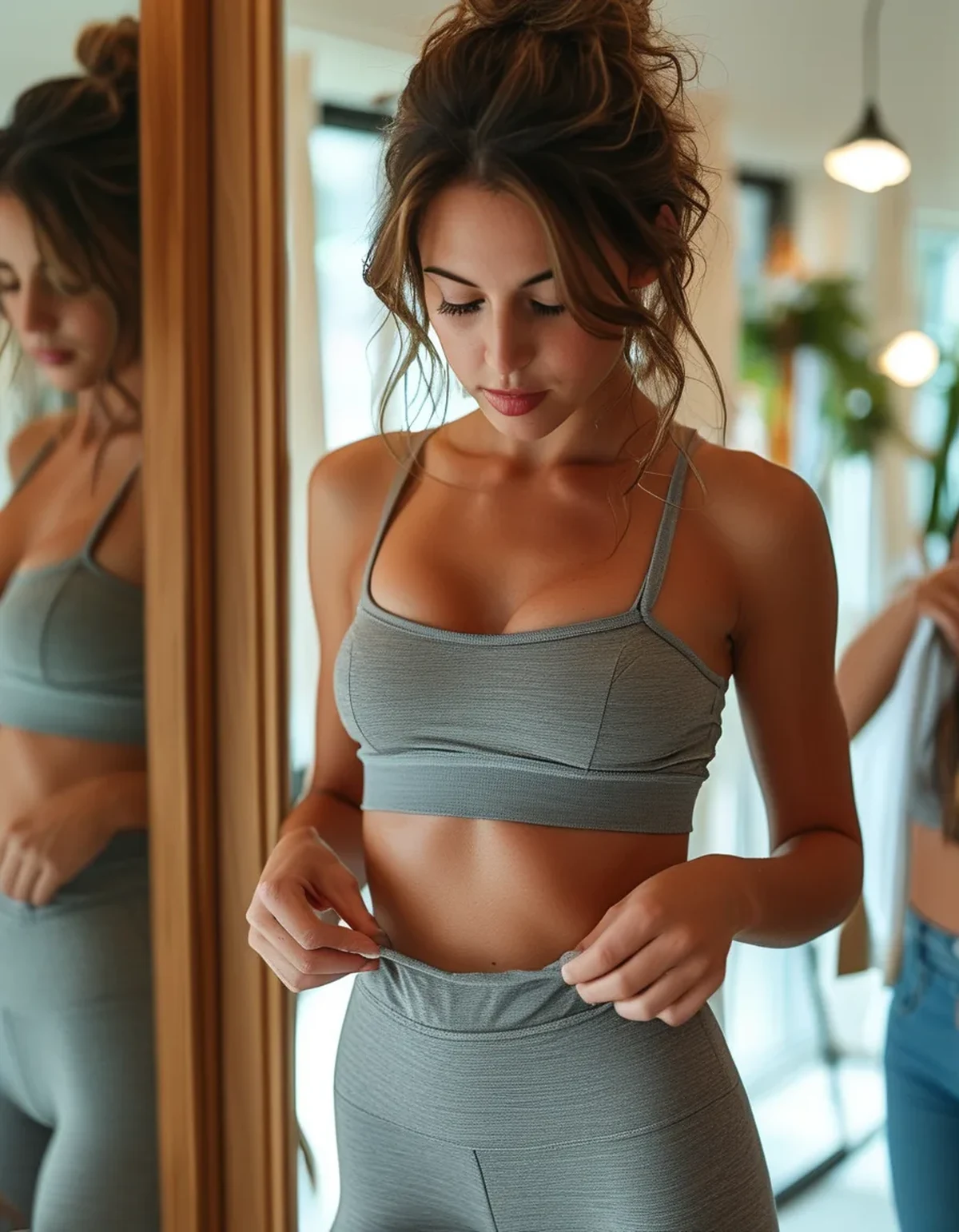
No gap — the crop meets or slightly overlaps the waistband. Reads as a continuous column, which lengthens. It is also the version most people find comfortable for everyday training. On a petite frame this often works better than the equivalent full-length top, because it puts the horizontal break at the natural waist rather than at the hip.
Small gap of a few centimetres. Shows the narrowest part of the torso and creates definition. This is the most commonly flattering configuration and the hardest to achieve accidentally, since it requires the crop length and rise height to be matched deliberately.
Large gap. Divides the body into three visible sections. On a shorter frame this tends to shorten, because the eye now has two horizontal lines to process in the middle of the body rather than one.
The practical implication: buying a crop without knowing which bottoms it will be worn with is guessing. A crop that is perfect with a high-rise legging can be unwearable with a mid-rise one.
What about the gap changing when you move?
This is where most crops actually fail. A hem that sits well standing still can ride up substantially when you raise your arms. If the garment is for training, test it with an overhead reach in the fitting room — that is the real length, not the standing one.
What to look for and what to avoid
Look for a stated garment length. Brands that list front length in centimetres for each size are telling you the one thing you need. Comparing that number to a garment you already own is far more reliable than any size chart.
Look for a hem with some weight or a band. A raw or very light hem rides up more. A finished band, a slight ribbing, or a marginally heavier fabric at the hem holds the position better through movement.
Look for petite-specific ranges in structured items. For a plain jersey crop, regular sizing is often fine. For anything with a defined underbust seam, built-in support, or shaping, petite drafting matters much more, because those features are positioned vertically and cannot be adjusted.
Avoid buying down a size to get a shorter length. This is the most common mistake, and it trades one problem for another — a smaller size is shorter and tighter, and the tightness causes it to ride up further, which undoes the length gain.
Avoid heavy or stiff fabrics in short lengths. A stiff cropped top on a shorter frame reads as a band across the body. Softer fabric drapes and follows the shape, which is more forgiving of imperfect length.
Avoid large horizontal detail at the hem. Contrast bands, wide logos, and prominent trims at the hem draw attention to exactly the line you may want to be quieter.
Can a crop be shortened?
Yes, and it is one of the easier alterations on jersey if the hem is simple. It is also the direction that works — a garment can be shortened, never lengthened, so buying slightly long and adjusting is the safer error.
5 mistakes with petite cropped tops
1. Shopping by size and ignoring listed length. Size controls circumference. Length controls proportion, and on a shorter frame proportion is the thing that decides whether a garment works.
2. Not testing with arms overhead. Standing-still length is not the length you will wear. Any training top needs to be assessed in movement, and most fitting rooms allow it.
3. Pairing a crop with mid-rise bottoms by default. The gap is what you actually see. A crop chosen for high-rise leggings will read completely differently over a mid-rise pair.
4. Sizing down to shorten. It works on paper and fails in practice — tighter fabric rides higher, so you lose the length you gained and gain a fit problem.
5. Assuming petite ranges are always the answer. Petite drafting helps most with structured and seamed garments. For simple jersey, a regular size with a known length measurement often gives more choice for the same result.
FAQ: Petite Crop Length Questions, Answered
What length should I be looking for?
Rather than a universal number, measure the top you like most from the highest point of the shoulder to the hem, and shop to that measurement. It is the single most useful number you can know about your own wardrobe.
Do I need to show any midsection at all?
No. A crop that meets a high-rise waistband gives you the raised horizontal line — which is the proportional benefit — with no visible skin at all.
Does this apply to cropped jumpers and jackets too?
Yes, and often more, because outerwear is stiffer and holds its length rather than draping. Cropped jackets are particularly sensitive to a few centimetres either way.
Why do two size smalls fit so differently?
Different brands draft for different heights and use different grading rules. Two identically labelled garments can differ by several centimetres in body length, which is precisely why the measurement matters more than the label.
Is a longline top better for a petite frame?
Not inherently. A longer top places the horizontal break lower, which usually shortens the leg line. The mid-length that ends at or near the natural waist tends to serve a shorter frame best.
What is the fastest way to improve this without shopping?
Pair the crops you already own with the highest-rise bottoms you own, and see which combinations close the gap. Most people find one or two pairings they had never tried.
TL;DR:
- On a shorter torso, a few centimetres of hem is a large share of the visible midsection.
- Length is graded by size rather than height, so a standard crop sits higher on a petite frame than intended.
- What matters visually is the gap between hem and waistband, not either measurement alone.
- Shop by stated garment length; measure a top you like and use that number.
- Never size down to shorten — tighter fabric rides up and you lose the length again.
Size solves width. Only length solves proportion, and length is the number almost nobody checks.
This is general information, not medical advice.
See It in Motion
Seen here: Super High Waist Embossed Yoga Leggings with Inner Pocket — shop it on bubblelime.com
Keep Reading
This article is for general informational and styling purposes only. Fit, sizing, and product availability may vary.