Petite Sizing Fixes the Inseam and Ignores the Real Problem
Quick Answer: Petite bodies aren’t just shorter overall — the torso is usually proportionally shorter too, so a standard high-rise legging that’s designed to hit at the natural waist ends up sitting at or above the ribcage. Petite sizing that only shortens the inseam leaves this uncorrected, which is why a properly hemmed pair can still feel like it’s swallowing your midsection.
Once you know to check the rise measurement rather than just the inseam, petite legging shopping gets a great deal less frustrating.

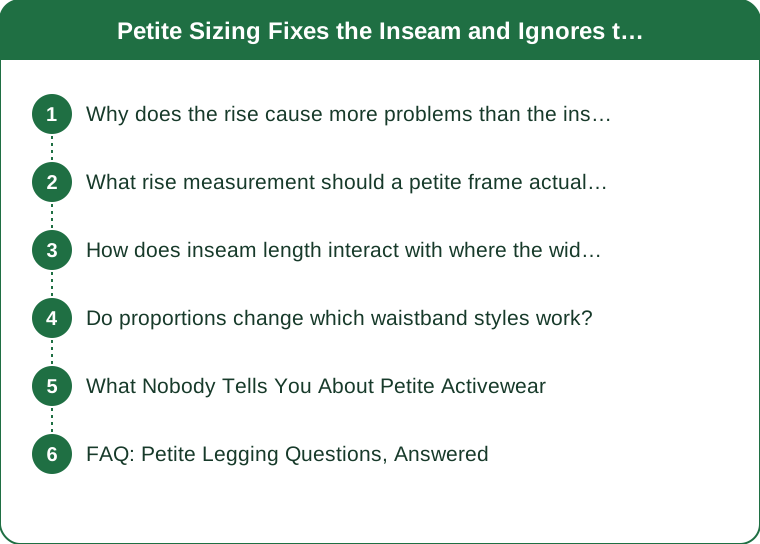
Why does the rise cause more problems than the inseam?
Because height differences are distributed across both the leg and the torso, but petite sizing usually only adjusts the leg. A standard high-rise legging might be designed with an 11-inch rise to hit the natural waist on a 5’6” frame. On a 5’1” frame with a proportionally shorter torso, that same 11 inches can land two inches above the natural waist — well into the ribs.
The result is a band that sits where the torso is widening again rather than at its narrowest point, so it feels like it’s constantly pushing down. A band that migrates downward all day is almost always a rise problem, not a size problem.
What rise measurement should a petite frame actually look for?
Rather than trusting the label, measure yourself: from the bottom of your torso at the crotch straight up to your natural waist — the narrowest point, usually just above the belly button. For many petite frames that number lands between 9 and 10.5 inches, compared with the 11 to 12 inches common on standard high-rise designs.
When a brand lists rise, compare against your number directly. When it doesn’t, a ‘mid-rise’ in standard sizing often functions as a high-rise on a petite frame, which is a genuinely useful shortcut. Buying the mid-rise version of a style you like is frequently a better fit than the petite version of the high-rise.
How does inseam length interact with where the widest part of the calf sits?
This is where 7/8 lengths cause trouble. A 7/8 legging is designed to end just above the ankle on a standard frame; on a petite frame it often ends at mid-calf or lower calf — right around the widest point, which creates a horizontal line at the leg’s widest spot and visually shortens it further.
The fix is to either go full-length so the line continues to the ankle, or go decisively shorter to a true capri that ends below the calf’s widest point. The in-between landing is the one that works against the frame. This is also why petite-specific inseams matter more for cropped styles than for full-length ones.

Do proportions change which waistband styles work?
Meaningfully. A very wide waistband — four inches or more — consumes a large fraction of a shorter torso, which visually compresses the space between the ribs and hips and makes the torso read shorter still.
A band in the two-to-three-inch range gives the same hold with less visual weight. A crossover or V-front band works particularly well on petite frames because the downward point of the V creates a vertical line that lengthens the torso, counteracting the horizontal compression a wide flat band creates. It’s a small detail with a disproportionate visual effect at this height.
What Nobody Tells You About Petite Activewear
Brand-to-brand variation exceeds petite-to-standard variation. One brand’s standard rise can be shorter than another’s petite. Measuring your own rise once and shopping by that number beats trusting size labels entirely.
Compression feels stronger on a petite frame. The same fabric stretched over a shorter rise sits under more tension per inch, which is why a pair that reviews as ‘gentle compression’ can feel firm.
Hemming full-length leggings is easier than fixing a rise. If a pair fits perfectly at the waist but runs long, that’s a $15 tailoring fix. A rise that’s wrong can’t be corrected at all — so prioritize the rise when choosing.
FAQ: Petite Legging Questions, Answered
Is buying a smaller size a substitute for petite sizing?
No — sizing down shortens the rise only slightly while making the leg fit too tight. The rise and the circumference scale at different rates.
Do petite frames need different waistband hold?
Not inherently, but a band sitting above the natural waist will always migrate regardless of hold strength. Fix the position before adding compression.
Are cropped styles worth it on a petite frame?
Only true capris that end below the calf’s widest point. A 7/8 that lands mid-calf is the length to avoid.
TL;DR:
- Petite sizing usually fixes the inseam and leaves the rise unchanged — the rise is the real issue
- Measure crotch to natural waist; many petite frames need 9-10.5 inches, not the standard 11-12
- A standard mid-rise often functions as a petite high-rise, which is a useful shortcut
- A 2-3 inch band or a V-front lengthens the torso; a 4-inch band compresses it
Inseam is the easy fix and the one brands market. Rise is the one that decides whether a pair actually works.
See It in Motion
Seen here: High Waist Yoga Leggings with Side Pockets — shop it on bubblelime.com
Keep Reading
This article is for general informational and styling purposes only. Fit, sizing, and product availability may vary.