Why Petite Jacket Armholes Decide Whether You Can Move
Quick Answer: Armhole height — how close the bottom of the armhole sits to your armpit — determines range of motion far more than jacket size does. A high, small armhole lets the sleeve move independently of the body, so you can raise your arms without the whole jacket lifting. A low armhole ties the sleeve to the body, so raising your arm drags the entire garment up. Petite frames are affected disproportionately because armhole depth is graded from height, and a small drop in the armhole eats a large share of a shorter torso.
It is counterintuitive and consistently true: smaller armholes move better than larger ones.

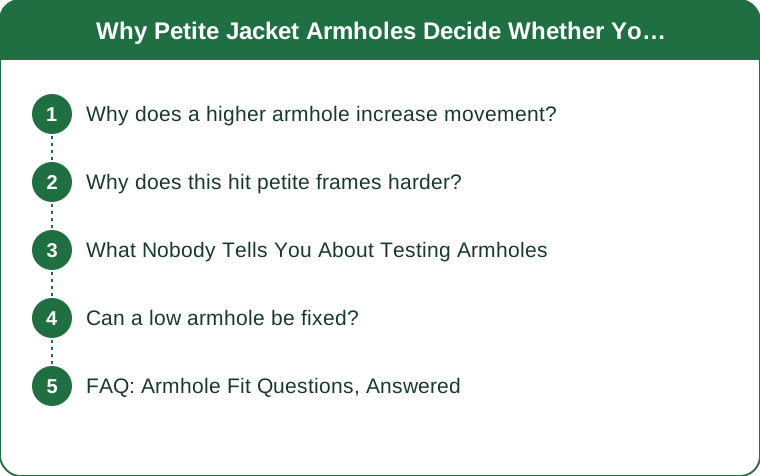
Why does a higher armhole increase movement?
Because it decouples the sleeve from the body of the garment.
When the armhole sits high and close to the armpit, the sleeve pivots around a small point. Raising your arm rotates the sleeve within the armhole, and the body of the jacket stays where it is. The garment moves at the joint, the way your own shoulder does.
When the armhole is cut low, the seam sits several centimetres down your ribcage. Now there is a large panel of fabric connecting your upper arm to your side. Raising your arm pulls that panel, and the panel pulls the entire body of the jacket up with it — hem rising, shoulders bunching, the whole garment shifting.
This is why a tailored blazer with a snug armhole often has better range of motion than an oversized jacket that appears roomier. Roominess in the body is not the same as freedom at the joint, and most shoppers judge by the former.
The rule holds across categories: dress shirts, coats, knitwear. Anywhere the armhole is high and neat, movement is better. Anywhere it is dropped for a relaxed look, movement is worse, and the relaxed look is paid for in mobility.
Why does this hit petite frames harder?
Because armhole depth scales with height, and the proportional cost is larger on a shorter torso.
Manufacturers grade armhole depth from overall height in their size chart. A jacket cut for a 5’7” frame might have an armhole depth of, say, 21cm from shoulder seam to underarm seam. Cut for 5’2”, it should be proportionally shallower.
When a brand grades the body length correctly but treats armhole depth as a minor adjustment — which is common, because armhole depth is invisible in a flat photograph — the armhole ends up disproportionately deep for the torso it sits on.
On a shorter torso, 3cm of extra armhole depth represents a much larger fraction of the distance from armpit to waist. The seam ends up sitting close to the waist, which means the connecting panel is enormous and the jacket lifts dramatically with any arm movement.
There is a visual cost too. A low armhole on a short torso shortens the apparent leg line, because it drops the visual boundary between upper and lower body. So the same flaw that costs mobility also costs proportion — which is why a jacket that feels restrictive often also looks slightly off without you being able to say why.

What Nobody Tells You About Testing Armholes
Test in the fitting room with the exact motion you need. Reaching for a seatbelt, lifting a bag onto a shoulder, reaching overhead. A jacket that passes a mirror check and fails a seatbelt reach will not get worn.
Watch the hem, not the shoulder. When you raise your arm, look at what the hem does. If it lifts more than a couple of centimetres, the armhole is too low. This single check identifies the problem faster than any measurement.
A tight armhole that pinches is a different problem from a low one. Pinching at the front of the armpit means the armhole is too narrow or the sleeve cap is wrong. Restriction with no pinching means it is too low. The first requires a bigger size; the second requires a different cut.
Stretch fabric does not fix a low armhole. Stretch helps with a narrow armhole. It does nothing about the geometry of a deep one, because the issue is where the seam sits, not how much the fabric gives.
Petite-labelled garments are not automatically better here. Many petite lines shorten the body and the sleeve while leaving the armhole close to standard. Checking the armhole is one of the few reliable ways to tell a genuinely re-drafted petite line from a shortened regular one.
Can a low armhole be fixed?
Sometimes, and it is worth knowing when it is not.
Raising an armhole is a real alteration and a moderately expensive one. The sleeve has to be detached, the armhole re-cut higher, and the sleeve re-set with the cap adjusted to the new opening. On a lined, structured jacket this is significant work. On an unlined knit it is much simpler.
Whether it is worth it depends on how much needs to come out. Up to about 2cm is straightforward on most garments. Beyond that, the sleeve cap no longer matches the new armhole shape and the sleeve has to be re-cut too, at which point the cost usually exceeds the value of anything but a treasured garment.
The better strategy is selection rather than correction. Once you know to look, armhole height is visible on the hanger — hold the garment up and look at where the underarm seam sits relative to the shoulder seam. Compare two jackets side by side and the difference is obvious in seconds.
And for the seasons ahead, this matters more in outerwear than anywhere else. A coat with a low armhole worn over a jacket becomes almost immobilizing, because you now have two low armholes stacked. Checking armhole height on a coat while wearing the layer you will actually wear underneath is the single most useful thing you can do in a coat fitting room.
FAQ: Armhole Fit Questions, Answered
How high is too high?
When it chafes at rest or restricts your arm hanging naturally. A well-cut armhole should sit close without contact when your arms are down. Discomfort standing still means too high; discomfort only when moving means too low.
Do drop-shoulder styles always restrict movement?
Mostly yes, by design — a drop shoulder places the seam on the upper arm and the armhole low. It is a deliberate silhouette rather than a flaw, but it should be chosen knowing the mobility cost.
Does this apply to activewear too?
Yes, and it is why performance jackets use raglan or gusseted underarm construction. Both are engineered specifically to solve the geometry problem described here, which is why a running jacket moves so much better than a fashion jacket at the same fit.
TL;DR:
- Armhole height, not size, determines whether you can move — smaller armholes move better than larger ones.
- A low armhole ties the sleeve to the body, so raising your arm lifts the whole garment.
- Petite frames are hit harder because armhole depth scales with height and is frequently under-graded.
- Watch the hem when you raise your arm; more than 2cm of lift means the armhole is too low.
Hold two jackets side by side and look at where the underarm seam sits. That comparison takes five seconds and predicts wearability better than the size label does.
Keep Reading
This article is for general informational and styling purposes only. Fit, sizing, and product availability may vary.